Site survey and consumption review
Day 1We come and look at the roof and read your hourly billing data. The point is not how much you use, but when: the hourly curve decides whether you need storage, and how much.
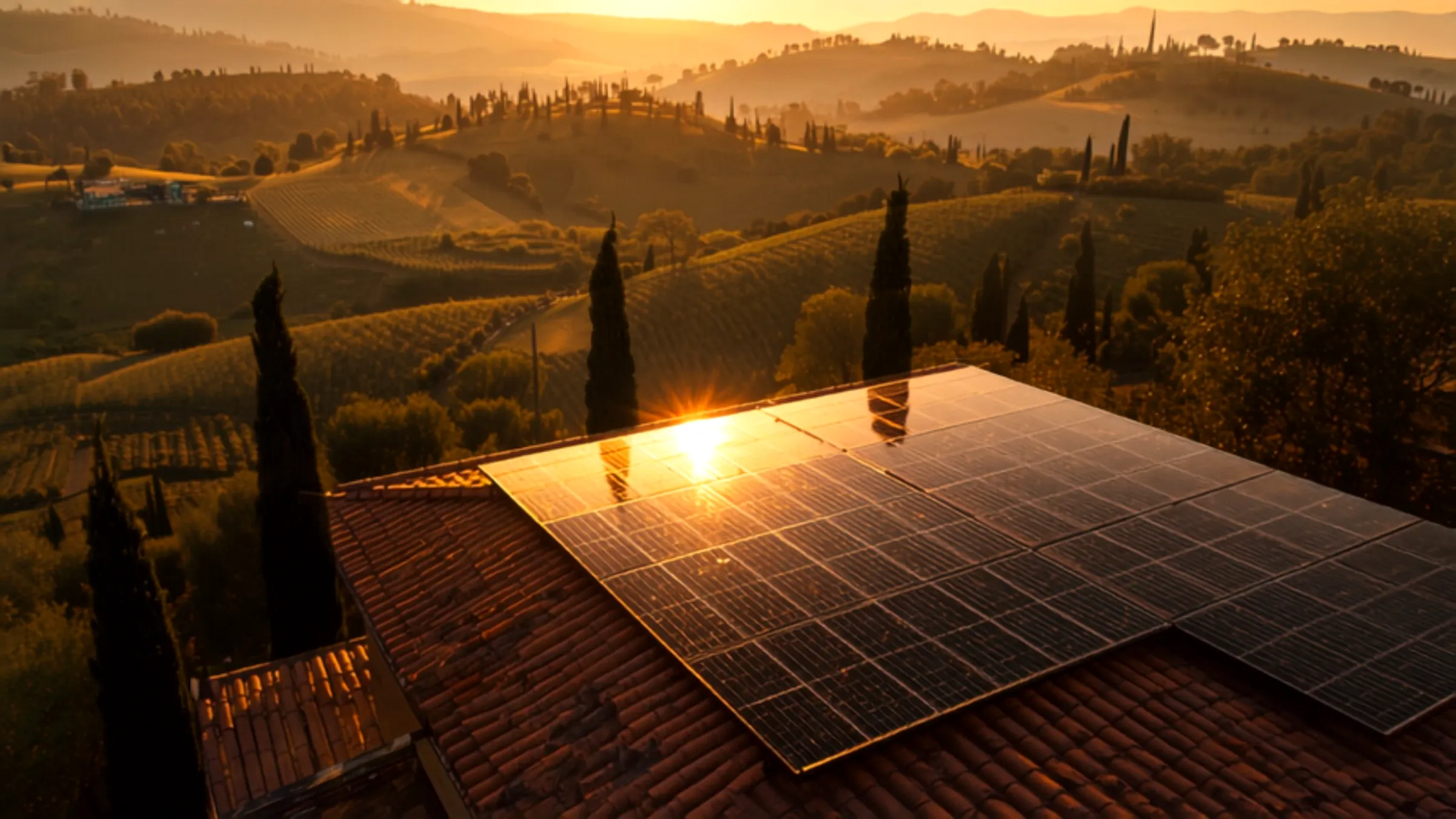
A solar system with battery storage, designed around how you actually use electricity. Generate by day, run on your own power at night — and the 50% tax deduction gives you back half the cost.
A solar system is not an eco-friendly purchase. It is an investment that stops costing and starts paying, usually somewhere between year three and year five.
Average yearly saving on a 6 kWp system with storage
Energy self-consumed with a battery, against 32% without
From first call to grid connection, paperwork included
Move your yearly spend and watch what changes. Every parameter is declared below — no numbers pulled out of thin air.
Add up the last 12 months of bills. If you don't have them to hand, a household of four typically sits between €1,200 and €1,800.
Without storage you use roughly 32% of what you generate. With storage that rises to around 72% — and that is the difference between a system that pays for itself and one that pays for itself quickly.
Indicative estimate based on conservative PVGIS yield figures, an electricity price of €0.25/kWh and a feed-in value of €0.10/kWh. A real quote starts with a site survey: roof, consumer unit and hourly consumption all change the result.
From the first call to grid connection takes on average two months. We handle the paperwork.
We come and look at the roof and read your hourly billing data. The point is not how much you use, but when: the hourly curve decides whether you need storage, and how much.
We size the system, prepare the electrical design and file everything ourselves: grid connection with the network operator, notification to the GSE, and the documentation you need for the tax deduction.
Panels, inverter, storage and monitoring. On a detached house it is done in two days. The consumer unit is brought up to code if needed, with no surprises on the invoice.
The network operator activates the exchange and you see generation and consumption live in the app. From that point the bill changes shape: you only pay for what you did not generate.
Product warranty plus linear performance warranty: after 25 years the panels must still deliver at least 85% of nameplate output.
Grid connection, GSE notification and the documentation for the tax deduction: we file them and follow them, not you.
We don't look at how much you use but when. The hourly curve tells us whether you need storage and how much.
Design, installation, connection and support are all ours. No passing the buck between installer, electrician and network operator.




Marco reads your hourly billing data before he ever climbs on the roof. He decides the system size and whether storage makes sense in your case — or would just cost you more.
The deduction is worth 50% of the cost, split into ten equal yearly instalments. On a €13,800 system that means €6,900 recovered, €690 a year for ten years.
There is one point almost nobody mentions before signing: the deduction is offset against the income tax you actually pay. If your yearly tax bill is lower than the instalment, the excess is lost and cannot be carried to the following year. That is why we ask for a rough idea of your taxable income when quoting: it lets us size the spend against what you can genuinely recover.
Check your situationA 6 kWp system on a detached house sits around €13,800, which becomes roughly €6,900 net after the 50% deduction. Adding 5 kWh of storage costs around €3,900 gross. The price per kWp falls as the system grows: below 3 kWp you pay more, because the fixed costs of installation and paperwork stay the same.
It is an income tax deduction on 50% of the cost, split into ten equal yearly instalments. On €13,800 you recover €6,900, that is €690 a year for ten years. Watch out for the point that always surfaces later: the deduction is offset against the income tax you actually pay. If your yearly tax is lower than the instalment, the excess is lost — which is why we ask for a rough idea of your taxable income when quoting.
It depends on when you use electricity, not how much. Without storage you self-consume around 32% of what you generate; the rest goes to the grid and earns you about €0.10/kWh, while buying it back in the evening costs you €0.25. With storage, self-consumption rises to around 72%. If nobody is home between 9 and 6, the battery is almost always what separates a seven-year payback from a four-year one.
Only if it is set up for it. A standard solar system disconnects automatically when the grid drops — that is a safety requirement, it protects people working on the lines. To have power during a blackout you need a hybrid inverter with EPS functionality plus storage: we can include it on request, and it has to be decided up front because it changes the inverter.
A system weighs about 12–15 kg/m²: almost any roof in good condition takes it without modification. The structural check is part of the survey. If the covering is near the end of its life, we say so beforehand: redoing the roof after the panels are mounted costs twice as much, because everything has to come off and go back on.
Panels carry a 25-year product warranty and a linear performance warranty: after 25 years they must still deliver at least 85% of nameplate. Real-world degradation is around 0.5% a year. The inverter is the component that ages first: budget for a replacement between year ten and year fifteen, roughly €1,200–1,800. Our 25-year figures already account for that cost.
The system is legally part of the property and increases its value, as well as improving the energy rating on the EPC. Deduction instalments not yet claimed pass to the buyer, unless the deed states otherwise. It is not a sunk cost: it is an asset that stays with the house.
Little, and predictable: an annual check of strings, inverter and connections, and a panel clean when needed — generally every two or three years, less where it rains regularly. Monitoring flags abnormal drops in output on its own, so a fault shows up before you notice it on the bill.
The survey and quote are free and without obligation. If your case doesn't add up, we'll tell you.
Book a survey